Wednesday, June 1, 2016
Cognilyze at the Internet Retailing Conference and Exhibition (IRCE) next week
will be attending the IRCE in Chicago next week.
This will be our 1st time attending and we are so
excited to find out why this is The Retail Industry’s
Leading E-Commerce Conference & Tradeshow
Email ari@cognilyze.com to schedule a short
meeting with us and learn about our unique
Psychology Based Personalization Tool
Wednesday, May 25, 2016
We are back from Las Vegas
We are back from Las Vegas where Cognilyze sponsored and attended Shoptalk, the NextGen commerce event at the fabulous Aria hotel. The exposure that Cognilyze gained at the show was unbelievable as retailers and strategic partners alike visited us on Main-Street.
The event culminated on the 3rd day of the show when our CMO, Ari Ginsberg presented our Psychology Based Approach to Personalization before an audience of executives from leading US retailers.
Monday, May 9, 2016
will be launching
Cognilyze-NP
The New-Product
to Shopper, Matching System
at
in Las Vegas
In a
world of “people who bought this also bought that” what do we do when nobody
bought this product before? New product launches drive the industry but current
recommendation tools are unable to match these products to the interested
shoppers. Using psychology based recommendation, Cognilyze creates
a psychological profile for every new product and recommends them to shoppers
with matching profiles, finding new and immediate markets for new products.
Ari Ginsberg, our CMO will be speaking at ShopTalk and announce the launch.
Tuesday, April 5, 2016
When “people did not buy this”
In a “people who bought this also bought that” world, what do we do if nobody bought this product before?
The E-Commerce world is driven by new product introductions. Amazon, for one, introduces close to a ½ million products on average each day. So, what should a retailer do when a new product is introduces and purchased by a new customer? What should they recommend next when the old “people who bought this…” is not applicable?
This is not a new issue and was raised already back in the 1990’s when Collaborative Filtering (the statistical model behind the “People who bought this… tool) was introduced to the market. This issue forced data companies and retailers to use alternative basic recommendation methods, like, category based and the like alongside the more sophisticated model.
But, say, we recommended products not based on what other people. What if we knew why they buy and base our recommendations on the psychological and behavior profile of the shopper? And, what if we created a psychological profile of every new product and matched the product profile to the shopper’s profile? Well, I believe that would be a perfect world. Welcome to the world of Cognilyze.
Thursday, March 17, 2016
Using products to sell products?
Shopper’s experience, understanding the shopper, engaging
the shopper, these are all buzz words that are supposed to lead to one thing,
selling more products to our existing customers. We spend many a resources
gathering more personal data, internal and external, prime and 3rd
party to analyze our shopper’s needs, wants, motives etc. Add to that statistical
collaborative filtering and we think we have a predictive home run. Still, the deduction we make from all this
data to predict the product he or she will buy next or the assumption that
people who buy the same product, like the same things, is a leap and a jump
that often misses the mark.
Understanding the shopper Vis a Vis the products they interact
with is a telling story that defines their relationship with your products. It
is this relationship that we want to nurture.
If the world had a limited number of products, yes, a
general assessment of a shopper based on various demographic attributes can
lead us in the general direction towards the products he would buy, but in our
world where products come in all shapes, sizes, styles and functionality in
each general direction, therefore, targeted, relevant predictions can only come
from analyzing the shopper in the products playing field.
In a world before Cognilyze, such a goal will result
in predictions based on category or other tagging missing out on the full understanding
of the shopper. In Cognilyze’s world we reach highly fine-tuned analysis of the
shopper using psychological attribute embedded in the products themselves. And
that is just the tip of the iceberg.
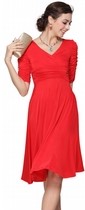
For example; this
women's dress has the following attributes Dress
comfortably, stylish/chic, Dramatic, Look fancy for a night
out, Stand out. (Notice the combination of motives and personality, I.E.
Dramatic, Stand out). When a shopper interacts with this dress, she assumes
these attributes as well as attributes of each subsequent product she interacts
with to build a psychological story of motives and personalities.
So, when Cognilyze uses buzz words like Shopper’s
experience, understanding the shopper, engaging the shopper, these are true
measures that emanate from the products to sell more products.
Saturday, January 16, 2016
Meet Cognilyze at NRF 2016
Want to hear more about Cognilyze's unique psychology-based product recommendation and personalization? Going to NRF2016? Message us now and we'll call you back to schedule.
Enjoy NRF!
Sunday, January 3, 2016
Will 2016 Be The Year Web Sites Understand Customers?
2015 was the year that privacy went bust. The collection and use of personal information has hit new highs, or maybe new lows. The flights we search for one minute are showing up in ads alongside our e-mail a minute later. Products referred to in e-mail messages or Facebook updates show up in ads on newspaper sites minutes later.
At the same time, however, none of this invasive technology gets any closer to knowing what we really want. I bought a heavy black raincoat at one online store in November, and within a week I got e-mail from that store with their “just for you!” recommendations, suggesting I buy one of three other black raincoats. In planning for a business trip to a colder climate, I really could have used gloves. When I bought a new smartphone, I was shown ads for the most popular accessories, but not the accessories that I would ever want to buy.
Bottom line, all the personal data being collected is not enabling web sites to really know what we want.
But 2016 is poised to be a watershed year in customer understanding. Cognilyze is bringing to market its psychology-based product recommendation engine for e-commerce sites. Instead of taking the same approach that today’s recommendation engines are taking, Cognilyze is taking an individualistic and personalized approach to understanding what individual customers want.
Existing systems all use variants on a technology called collaborative filtering, which dates back to the early 90’s. The modern form of item-to-item collaborative filtering basically says to recommend you the products that were bought most by the people that bought the same products you bought. This makes sense, and it works to a certain degree, but unfortunately the products most commonly bought by customers who bought coats are other coats.
Cognilyze’s technology takes another approach. If someone bought a heavy coat, they may be traveling on a business trip to somewhere cold, or they may be going skiing, or they may be replacing a coat to wear around home during the winter. If they buy a red, coat, they may be attention-seeking by nature, or red may be “in” in their social circles. If they buy a coat without a hood, they may be conservative by nature, or they may be buying a coat to wear to work and be worried about maintaining a professional image. These and other details together paint a much different picture of each customer, based on conclusions about why they bought the products they bought..
Once each customer is better understood, they can also be recommended products that match their motivations and preferences much more closely. Someone going on a business trip to a cold place may want professional-looking warm gloves, while someone going skiing will want ski gloves. Someone who is attention seeking will want certain things, while someone worried about maintaining a professional image will want other things. Someone who is extroverted will likely want the most outgoing products in any category that they search or browse, not only for winter clothing. Someone who is trendy will likely want the latest hot brand of shoes on the market, while someone who is conservative will want established brands.
Bottom line, the psychology that underlies customer purchases, the “why,” makes all the difference in what recommendations will catch their interest. A system that can determine customer motivations and preferences will generate recommendations that meet customer interests and thereby make more sales.
There are other advantages to psychology-based recommendations. For years e-commerce analysts have been discussing the “long tail” of less popular products. The short head of popular products are stocked in stores, while the long tail of less popular products are more easily sold online, where shelf space is not an issue. But recommendation engines using collaborative filtering, based as they are on product popularity within clusters, will never recommend products in the long tail. Cognilyze’s individualistic approach is agnostic to popularity.
Cognilyze’s psychology-based recommendation engine has achieved four times the click-through rate than recommendation engines current in use, in trials with major retailers. We are currently working with more retailers to get the system into broader use.
If we’re going to be receiving ads, e-mail promotions, mobile notifications, and all the other forms of product recommendations, wouldn’t it be great if the recommended products were actually the things we want?
With technology like Cognilyze’s, 2016 can be the year that e-commerce sites truly begin to understand their customers.
Subscribe to:
Posts (Atom)